

The rapid emergence of Generative AI is fundamentally changing how we work and learn. Organizations are struggling with how to support employees in developing GenAI skills while ensuring responsible and effective use.
My AI Skills vs Systems Impact Matrix is for managers and HR to balance individual GenAI skill development with systematic organizational support.
Understanding the Four Quadrants
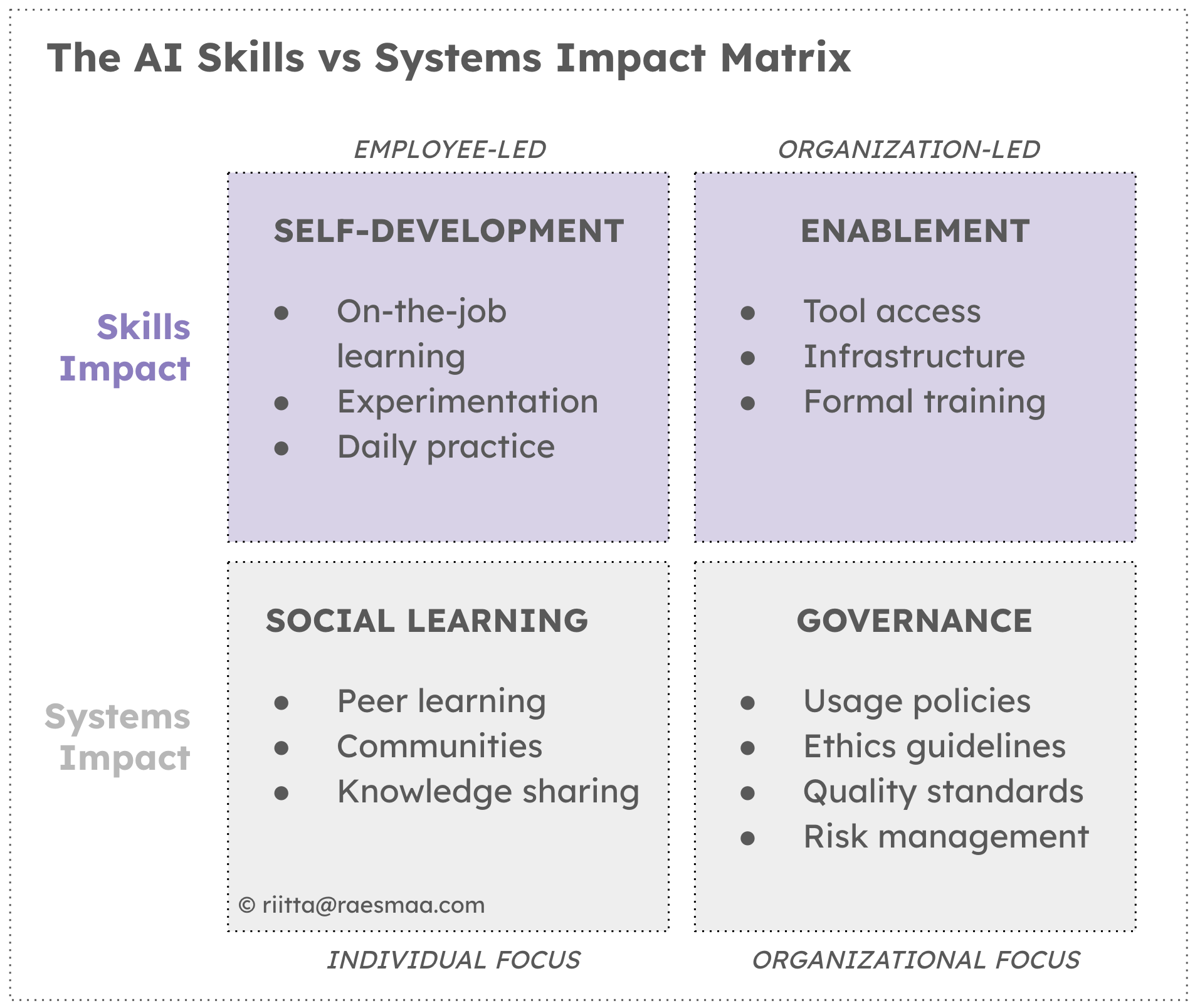
The model is structured around two key dimensions: Employee-led vs Organization-led initiatives, and Individual vs Organizational focus. This creates four distinct quadrants, each playing a vital role in the GenAI learning ecosystem:
Self-Development (Employee-led, Individual Focus)
Self-directed learning lies at the heart of GenAI skill development. This quadrant represents where most actual skill acquisition happens – through experimenting with prompts, trying out new AI tools, and learning by doing. It’s the quadrant where employees take ownership of their AI learning journey.
Social Learning (Employee-led, Systems Focus)
Learning in general, and with GenAI specifically, doesn’t happen in isolation. The social learning quadrant emphasizes the power of ‘prompt-sharing’ communities, peer learning about AI applications, and knowledge sharing of both successful and unsuccessful use cases. It’s where individual AI experimentation meets collaborative learning — at best creating a community of practice. (My Canadian friend, organizational learning pioneer Harold Jarche has been advocating for communities of practice for ages.)
Enablement (Organization-led, Individual Focus)
Organizations (management, HR, and IT) play a crucial role in providing AI infrastructure and tools. While formal AI training is part of this quadrant, it’s equally about ensuring employees have access to appropriate AI tools, computing resources, and data to support their development. This focuses on establishing reliable minimum capabilities for all employees in specific roles.
Governance (Organization-led, Systems Focus)
The governance quadrant provides the framework that ensures AI initiatives align with organizational goals, standards, and legal requirements. Through usage policies, AI ethics guidelines, quality standards, risk management, and compliance measures, it creates the structure needed for responsible and sustainable AI adoption.
The 70:20:10 Model – Adapted for GenAI
I love the 70:20:10 model by McCallin, Lombardon ja Eichinger. Their model suggests that 70% of learning happens through self-development, 20% through social learning, and 10% through formal training.
However, in the context of GenAI adoption, I’ve modified these proportions: while keeping 70% for self-development and 20% for social learning, I suggest 8% for formal enablement, and for most organizations, the final 2% acknowledging the critical role of governance in responsible AI adoption. This small but crucial governance component is my addition to this classic model, ensuring that learning translates into responsible and effective AI use while reflecting the unique challenges of AI adoption.

AI’s Impact on Learning Distribution
In the future, we’ll likely see some movement between the self-development (70%) and social learning (20%) proportions as we will be better at how we collaborate.
The shift requires organizational support from L&D and HR/IT teams to create collaborative environments and facilitate peer learning. However, the fundamental principle remains: employee-led learning will continue to dominate the learning landscape.
Why This Matters
By understanding these relationships, organizations can balance investments across all four quadrants. Self-development and social learning carry more weight than most decision-makers realize, while organizational support and governance ensure sustainable and responsible adoption.
This balance between bottom-up learning and top-down support creates the Yin & Yang of Learning that enables both individual growth and organizational development.
Riitta 🌟
Need support with your organization’s GenAI journey? Connect with me on LinkedIn – https://www.linkedin.com/in/raesmaa/ where I also share my ideas and insights.






 raesmaa.com
Your comments