

Contracts drafted in seconds. Data analysis completed before your coffee cools. Tasks that once demanded expertise now handled by algorithms. Across law, consulting, and accounting, professionals are watching their value erode in real time. As professionals across fields watch their roles shift or shrink, it’s becoming clear: we’re not all prepared for this rapid transformation. And if history is any guide, this points to a crisis. Larry E. Greiner’s half-century-old model of organizational growth offers a surprisingly relevant lens.
Greiner’s Growth Model outlines how periods of stable growth are inevitably disrupted by crises that force organizations to adapt. In the age of AI, this cycle may be accelerating.
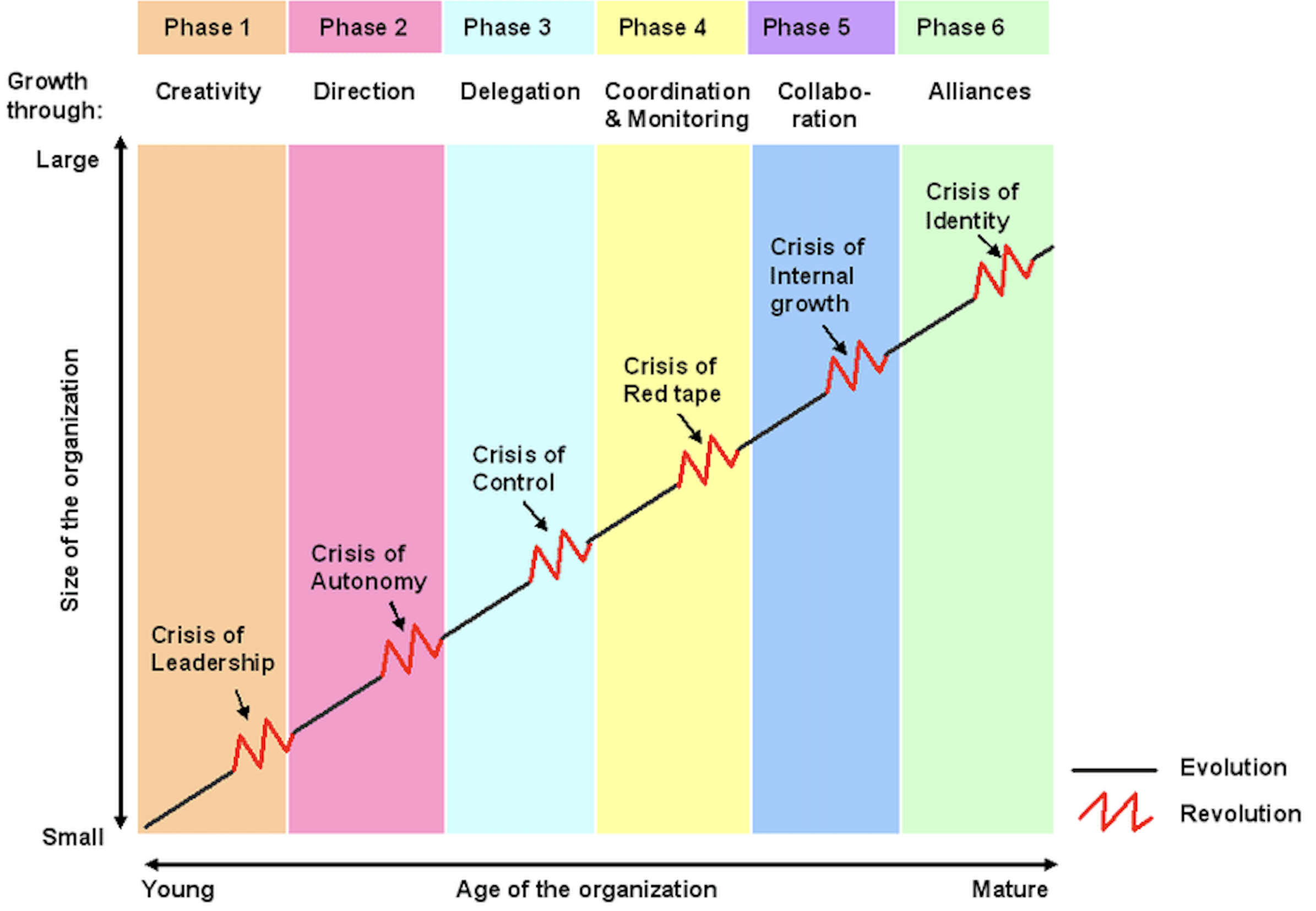
The model describes how organisations typically develop through five stages, each including a period of evolution and growth followed by a crisis (revolution).
The First Six Stages
The first six stages of the growth model, and the crises that follow them, are as follows:
Stage 1: Creativity → Leadership crisis
The startup phase is when a small team focuses on creating a product and market. Professional management resolves the crisis.
Stage 2: Guided growth → Autonomy crisis
Hierarchy and processes bring order, but ultimately stifle initiative at lower levels of the organisation.
Stage 3: Delegation → Control crisis
Decentralised decision-making frees up energy but leads to various coordination problems.
Stage 4: Coordination → Bureaucracy crisis
The number of systems and processes increases and may eventually become an end in itself.
Stage 5: Collaboration → Psychological fatigue
Teamwork and behaviourist leadership work until people become tired of constant collaboration and pressure to innovate, or constantly coming up with something new.
In 1998, Greiner added a sixth stage to his model: growth through external solutions (e.g., outsourcing, mergers, and networks).
Will AI trigger a 7th stage of growth?
Artificial intelligence is a powerful catalyst for change in knowledge work. Analysts, consultants, lawyers, accountants, and many other professionals must rethink their roles and professional identities. Artificial intelligence is already capable of performing a wide range of tasks faster and more accurately, which poses challenges both to individual identity and to change management.
We need a seventh stage in Greiner’s model. This could be growth through human-AI collaboration.
Stage 7: Humans + artificial intelligence
This stage, known as the Evolution stage, covers the following, for example:
- Smooth cooperation between humans and AI in knowledge work at all levels of the organisation
- Routine tasks are handled by automation, allowing humans to focus on creative problem-solving
- Data-driven decision-making and real-time analytics
- Artificial intelligence supports strategic planning and forecasting
- Continuous learning (both humans and artificial intelligence)
This phase develops knowledge work. Advantages include faster decision-making, better data use, a more personalized customer experience, and the ability to handle more complex problems. Experts can focus on ”higher-level” thinking and more strategic work. You would think that every manager and expert would love this, but it’s not that simple.
Why? Remember that in Greiner’s model, the evolution phase is followed by a revolution phase, i.e., a crisis. The next crisis could be something like the one I describe below.
The Coming Human Crisis
My guess for the next revolution phase is a human crisis.
Following Greiner’s prediction of psychological saturation in the fifth phase, a strongly AI-driven organisation will undoubtedly face its crisis. It could be a human crisis and include something like the following:
A crisis of meaning. Knowledge workers may initially actively resist the use of AI if the value of their expertise is questioned. Even the perception of devaluation can trigger resistance.
The devaluation of expertise. Knowledge and skills acquired through years of experience lose their value when AI can do the same thing faster. This significantly impacts marketing, communications, and consulting.
Ethical confusion. Decisions based on algorithms and their consequences cause moral conflicts. Who is responsible when artificial intelligence makes a mistake? How do we ensure that the algorithm does not discriminate? What if AI recommendations conflict with human moral intuition?
Management’s fear of losing control. Managers feel they are losing control of decision-making processes. How do we manage when artificial intelligence is involved? What kind of leadership is needed when artificial intelligence changes our work?
Humans + AI
Each of these crises will be resolved when we move on to the next stage of development. The solution to the human crisis will probably be found in learning to use AI to strengthen human potential rather than replace humans.
I predict that this will eventually lead to the 8th stage, which could be called ’Growth through symbiotic intelligence,’ i.e., an organisational model in which the strengths of humans and machines complement each other optimally.
Personality and AI Compatibility
Is everyone’s personality suited to a work environment where artificial intelligence is present?
In Greiner’s original model, he makes an interesting speculation about the fifth stage:
’Intensive teamwork can dissipate employee efforts, on the one hand, while on the other, some may find the new behavioural concepts and techniques incompatible with their personality structure.’
The same question is relevant to AI: Does everyone’s personality fit into a work environment where AI is strongly present and acts as a co-worker?
Professionals who do knowledge/thinking work and have built their identity mainly on their expertise may feel anxious, and quite rightly so. In my bubble, I have noticed that some journalists and communications professionals are struggling with AI. A word of comfort: high-quality content still requires thinkers and wordsmiths. We will move forward through crisis and experimentation.
What is the advice?
Knowledge workers, prepare for your job description to change fundamentally. Develop skills in which humans are (still) better than AI: empathy, creativity, and ethical judgement. Develop your problem-solving skills together with AI. Denial will not get you very far.
HR professionals, internalise as soon as possible that introducing AI is a long process that requires cultural change. This means new responsibilities for human resources management. Create a sense of security amid uncertainty and allow people to learn and grow into new roles. Updating the training calendar is not enough at this point. Competence development is too important to leave solely to HR. You need others to get involved.
As a leader, identify where your organisation is in implementing AI. This is not always easy to identify (due to shadow AI). How does your organisational culture relate to AI? Remember that this demands change management and is not a typical technology implementation. It is about people’s identity and motivation, affecting everything they do. Invest as much in supporting people as you do in technology. And don’t push this onto HR alone.
Crisis pushes towards change
AI significantly impacts people’s identity and motivation at work, requiring some kind of change management 4.0. People’s fears and prejudices towards artificial intelligence are genuine and often justified.
At this point, Ismo Alanko’s Finnish rock lyrics in the song ’Kriisistä kriisiin’ (From crisis to crisis) start playing in my head. Perhaps the current crisis is a natural state for organisations, at least in the technology sector. Every solution creates new challenges, which is a good thing. Crises force us to develop and find new solutions.
Learn from crises. You will learn about yourself and your organisation.
Riitta

 raesmaa.com
Your comments