

I’ve earlier blogged about how I find intuition and seeing the value of tacit knowledge to be very interesting perspectives for decision-making. As social business and new ways of working are now changing organizations and the entire business landscape and further adding to the complexity, I’ll find it even more interesting to study decision-making and how understanding is created.
I was looking for something else from my bookshelf and found the good old book by Stephen P. Robbins “Essentials of Organizational Behavior”, and randomly checked out the chapter about individual differences in decision-making. What I found was an interesting quadrant that describes the leadership styles related to decision-making; it has two axes: Way of Thinking and Tolerance for Ambiguity. The four decision-making styles are: Directive, Analytical, Conceptual, and Behavioral.
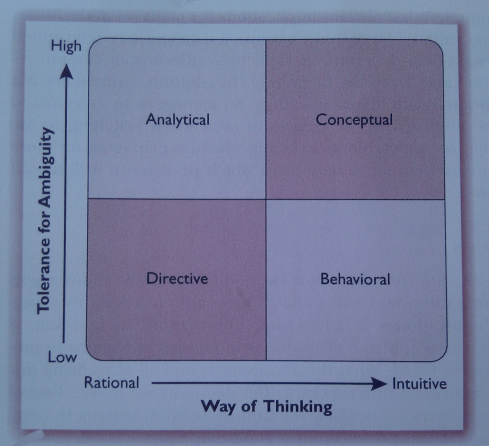
So here’s a quick go-though of this model, followed by my free associations from it.
- Way of Thinking, very simplified: Logical, analytical leaders process information serially versus intuitive and creative ones who perceive things as a whole.
- Tolerance for Ambiguity, again simplified: Some people need to structure information to minimize ambiguity, while others can process many ideas and thoughts simultaneously.
A very quick comparison of the types (yes, pretty obvious ones; you can hop over to my associations if you like):
- Analytical leaders have a better tolerance for ambiguity than “traditional” directive decision-makers. Analytical leaders usually seek more information and alternatives than directive ones.
- Leaders applying the conceptual style in decision-making often consider many alternatives from a broad perspective. Additionally, they take a longer-term perspective. This style gives most room for creativity, the authors claim.
- The fourth style, behavioral style, is the most receptive to suggestions from others, peers, and subordinates. Leaders of this style love meetings! They also try to avoid conflicts and find a consensus.
In Finland, we call the behavioral style a Swedish leadership style: it is based on utter politeness and caution and taking ages to make any decisions. Meanwhile, the traditional Finnish way has been the opposite: very direct, focused on the matter (seeing people as resources, no space for feelings here), and with a low tolerance for ambiguity. Formal business education in Finland has emphasized rational analysis and thinking for a long time, which has led to this ’inflexible’ style. Naturally, leadership styles are developing here in the Nordics, too. But I think we Finns have much more homework to do than our friends in Sweden.
An essential perspective on this very topic comes from the always-inspiring Rachel Happe, who recently blogged about decision-making in the networked world; here’s a quote from her excellent post:
“We need to move forward boldly and make decisions despite incomplete information… but also be prepared to change our path. It’s easy to just shut down when faced with an environment in which you can never be certain or absorb all the information available. But if you are a leader, you need to accept the uncertainty and move forward anyway. “
I very much agree with her, and that is exactly why I wanted to look at the model via three associations I spontaneously got.
My three spontaneous associations on the model
This decision-style model gave me the following associations:
- Systems Intelligence Theory of Esa Saarinen,
- Value and Importance of Serendipity (the weak links and the edges),
- Value and Importance of Listening.
Firstly, this decision-making style model and its division are associated with the Finnish philosopher Esa Saarinen and his research on Systems Intelligence. Daniel Kahneman’s research inspired them.
Saarinen and his fellow researchers describe the two ’thinking systems’ we all have: System 1 thinking as automatic, associative, and intuitive. System 2 thinking dominates in the workplace: you had better be strictly rational. In everyday work situations, System 2 thinking is active and often unintentionally blocks System 1 thinking, therefore narrowing the possibilities at hand. When both systems are active, there’s room for intuition, interaction, and emotions – and for better understanding and decision-making.
Being strictly rational in your work role is not working anymore. We need to utilize our full potential. I have blogged about this earlier e.g. in posts ”Mental Bodybuilding for Knowledge Workers” and ”Are You Systems Intelligent?” featuring my favorites Hagel and Saarinen.
Secondly, I thought of the ongoing lovely discussion about serendipity, a discussion in which John Hagel, Luis Suarez, and Ana Silva are the ones I love to follow, interact with, and listen to. When I saw the decision-style model, I immediately thought about replacing the Tolerance of Ambiguity with the Level of Embracing Serendipity.
It would broaden the model towards the thinking of the “Power of Pull model” (by John Hagel, Lang Davison & John Seely Brown). I agree with them that the cloud-enabled new platforms for serendipitous encounters lead to new kinds of innovation, decision-making, and leadership. We can now easily meet companies, and people we did not know existed, which helps us be more creative and broaden the basis we rely on when making decisions. The edges are fruitful places for innovation, to help us make innovative decisions and to support a better understanding.
Both Esa Saarinen and John Hagel and his fellows suggest an approach that helps us achieve our full potential as individuals. The same applies to our organizations and the people in them. In addition, serendipity can be shaped and utilized in decision-making.
The third association I got is the value and importance of listening in decision-making and in life in general. I serendipitously bumped into a beautiful TED Talk by Julian Treasure (what a lovely last name he has) about the importance of listening.
I warmly recommend listening to his talk (7:50 min); it is very inspiring.
Indeed, active listening deserves our attention in the chaotic and changing environment, but it is too often forgotten. In his talk, Julian shares five tips for better listening. I found the fifth one, his RASA model, beautiful and absolutely something every one of us should apply in our daily lives and decision-making situations. The acronym RASA comes from Receive, Appreciate, Summarise, and Ask – and these four verbs should be part of our personal decision-making, learning processes, and leadership.
Julian says aptly, ”Conscious listening creates understanding.” I’d like to add that you should listen to yourself as well as your peers, colleagues, family members, and friends.
I believe that better decisions and shared understanding are both enabled by these notions we associate with social business:
Genuine interaction, collaboration, learning, openness, sharing, trust, P2P instead of B2B & B2C, living network instead of stiff hierarchies, listening, intuition, passionate creativity, and embracing serendipity.
All these lead to not only learning and better understanding but also to better decision-making and success in whatever you are doing.
Personally, I have so many things that I need to do differently. Starting today.
–Riitta
Related reading:
Rachel Happe’s beautiful post: A Vision of The Social Organization
Dave Gray in Dachis blog: The Connected Company
Christoph Schmaltz in Dachis blog: From traditional business to social business
John Hagel’s grain of gold: Reshaping Relationships through Passion
EDIT 2011-08-02: Professor Esa Saarinen’s research can be found here.









 raesmaa.com
Your comments