Skip to content

Posts tagged ‘Social Media’

Human Capital in the Cloud

Clouding enables beautiful things - talent management in a new way. Why don’t we speak more often about Human Capital (HC) instead of Human Resources (HR)?

Read more

Social Media, Value Creation and the Risk of Missing Out

Knowledge workers must change, adopt and adapt: the way we learn, listen, help, discuss, search, collaborate, combine, produce, and create value.

Read more

Best Practices, Enterprise 2.0 and Social IT – with Passion

Focus on people practices, have healthy attitude towards control and risks, nurture relationships, networks & innovation, think power balance and ‘people units’.

Read more

Game Mechanics and Landscape Design for Customer Value Creation

We need new structures of work, language bath, and the process of helping.

Read more

Social Wolf in Sheep’s Clothing, ready for the Social Business?

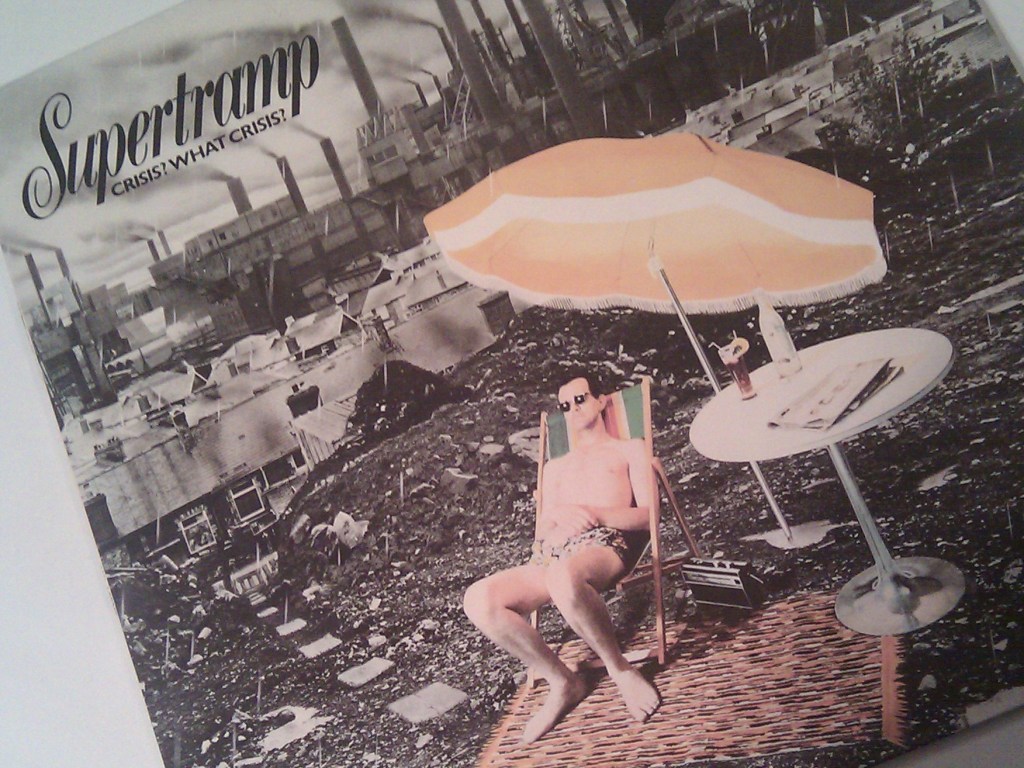
Supertramp album from 1975 – Photo by me

I recently found my old thesis, and yes, some of its topics and content are (still) relevant, as this one: the evolution of organization and work structures. The very same topic Esko Kilpi is researching. The discussion in my old thesis and Esko’s blog posts inspire me to learn more about this topic.

One chapter in my thesis starts with a quote by Michael Porter:

“Industries are profitable not because they are sexy or high tech; they are profitable only if their structures are attractive.”

Well put. Many industries and organizations are trying to score right under the constant change requiring new type of more adaptable structures. The development has been very rapid and raises increased demand for choice, chance, change and flexibility.

Read more

Entrepreneur: An Adventurer with Inbuilt Crap Detector

Guy Kawasaki’s Note to Me @ Paris 2010

Inspired by an interview of Francis Ford Coppola and by an old article about Ernest Hemingway, I compared their advice to my experiences as an entrepreneur.

I’ve blogged earlier about my favorite topic, tacit knowledge and its role in personal and organizational learning. Francis Ford Coppola’s words took me back to these thoughts. In the web magazine The 99 Percent’s interview  ‘On Risk, Money, Craft & Collaboration’ he describes his working methods and techniques, for example how making notes, e.g. writing down the first impressions of a novel, helps him to find what’s essential in it.

I have a habit of making notes all the time, not only in work related meetings and workshops, but also of novels, TV programs, movies, and discussions. When I look back at my notes I often find a new angle to the subject at hands, and realize that often my notes are implying something tacit, a piece of knowledge, an idea based on the quick unconscious association.

In the beginning of interview Mr. Coppola presents his code of ethics that directs his filmmaking. I’ll find it very interesting:

  1. Write and direct original screenplays
  2. Make them with the most modern technology available, and
  3. Self-finance them.

With little bit of imagination I dare to compare this to mine and my friends’ situation as entrepreneurs. These points tickle my thinking: Firstly, for an entrepreneur it is important to have a clear vision based on your big idea, which in turn should be based on the real customer need you’ve seen, maybe based the weak-ish signals you’ve seen before others have. Anyways, your basic idea must be robust. It is your original screenplay, your starting point.

Secondly, Coppola’s request for the most modern technology: that’s an easy one. In my case it is about utilizing Cloud Computing and during the coming months I need better understanding what part Social Technology have in my business. I have no clear picture of it yet. There’s luckily a very interesting discussion on-going (in Twitter) about social business. Just search #socbiz or #e20 in Twitter, and you’ll see what I mean. Learning new things daily!

Francis Ford Coppola’s third point about financing is one of the key (worrying) issues for an entrepreneur. As both in filmmaking and for entrepreneurship, it is a question about how much independence you have. For Coppola financing must be easy nowadays, but for young entrepreneurs it is often a major pain. It takes a lot of energy and time, which temporarily can cut off some of the enthusiasm.

Learning, Risk Taking and Collaboration as Key Capabilities

All these essential issues points at learning, our capability to unlearn and learn is central. To change and to be able to see what is not visible: the tacit things, the weak signals. One sentence in Coppola’s interview shows how important learning is even with 45 years successful career, he says:

I just finished a film a few days ago, and I came home and said I learned so much today. So if I can come home from working on a little film after doing it for 45 years and say, “I learned so much today,” that shows something about the cinema. Because the cinema is very young. It’s only 100 years old.

His humble quote is very true in any business. As our business environment is in huge change, we need to see it as new every day. For an entrepreneur this means making best guesses and taking risks. Francis Ford Coppola asks a striking question to which every entrepreneur can relate to:

If you don’t take a risk then how are you going to make something really beautiful, that hasn’t been seen before?

Indeed. Further Mr. Coppola shares his idea of collaboration and his role as a director, with wise words:

You must never be the kind of director, I think maybe I was when I was 18, “No, no, no, I know best.” That’s not good. You can make the decision that you feel is best, but listen to everyone, because cinema is collaboration. I always like to say that collaboration is the sex of art because you take from everyone you’re working with.

His words remind me of Mitch Joel’s recent post ‘Market of One’, where he writes:

Just because you do something (or don’t do something) is no indication of how the market actually is and reacts.

A recommended read, you may recognize the pattern in your business environment, among partners, business angels, VCs. For an entrepreneur it is vital to listen to everyone, be curious, to truly collaborate, and not make assumptions based on your personal opinion only.

To me entrepreneurship is about learning, experimenting, collaborating, and taking risks. It is an adventure. And I feel like an adventurer.

We all have our own personal methods and tools to manage the adventure. For me it is a cocktail of many things, the base on my beloved Systems Thinking, but to name one thing that has changed my way of working: social media. After I’ve managed to find ‘my people’, especially in Twitter, social media has opened a new world of knowledge sharing and valuable, most interesting global network of smart people. Whenever I have time to participate I learn.

Another result of intense learning and studying within social media sphere is this blog. I started blogging as I felt that I need to write down the (often unstructured) ideas and thoughts, and get feedback from my network of smart people. The feedback is very valuable for the learning process: when I write I am often developing an ad hoc idea and the feedback makes me think and rethink. I do need that.

Related to this experience of making notes and blogging too, I share a wonderful old article of Hemingway in Cuba (The Atlantic, 1965) which partly inspired me to write this post. Hemingway experienced writing as inventing. Here’s a quote by him which I like very much:

Fiction-writing, Hemingway felt, was to invent out of knowledge. “To invent out of knowledge means to produce inventions that are true. Every man should have a built-in automatic crap detector operating inside him. It also should have a manual drill and a crank handle in case the machine breaks down. If you’re going to write, you have to find out what’s bad for you. Part of that you learn fast, and then you learn what’s good for you.”

That’s basically what every entrepreneur needs too: Knowledge (network) out of which to invent, and a curious, open mind with a built-in crap detector.

I believe I don’t have to explain that.

I Gogoled: Social Communities and the Russian Classics

I didn’t google, but I Gogoled a bit. This post is not dead serious, it’s a product of my odd association – consider yourself warned.

I have always loved the Russian classics, especially novels by Nikolai Gogol, Anton Chekhov, Fyodor Dostoyevsky, Leo Tolstoy, and Mikhail Bulgakov. Many experience these as too heavy and melancholy, but not me. Ha, I’m a daughter of a librarian.

I am lucky to have a great people around me, many very vibrant ‘souls’, both people that are close to me in real life and also lovely personalities I’ve met in the social communities, especially Twitter. And from the vibrant, living souls my thought wandered to Gogol’s Dead Souls.

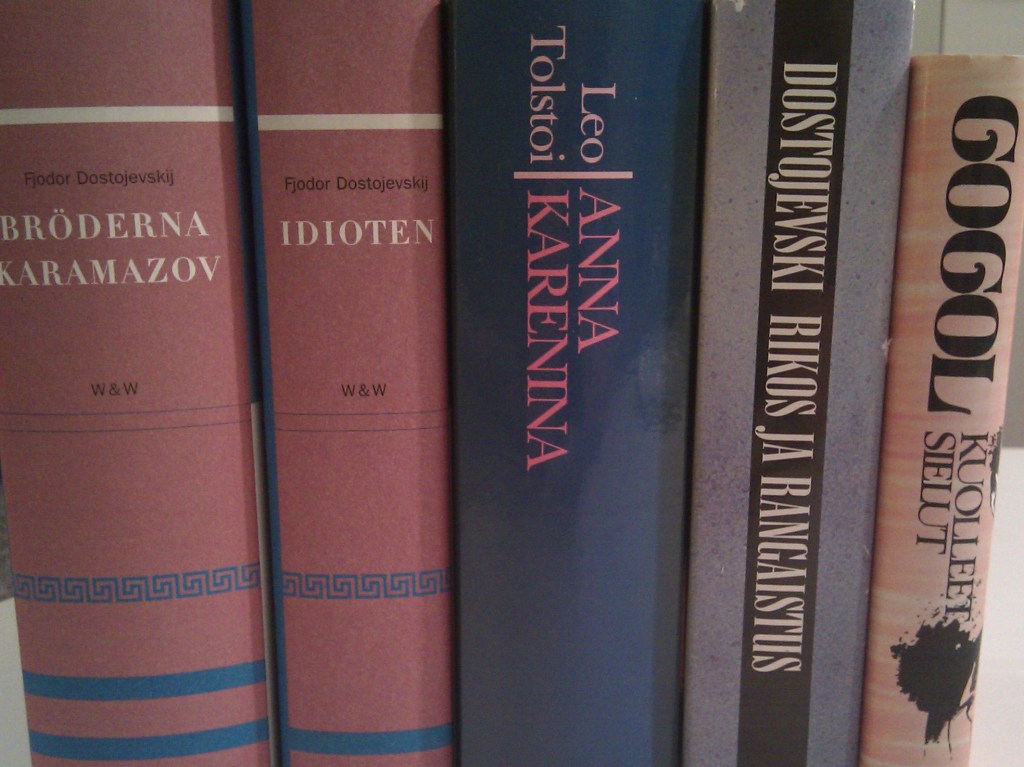
I picked up three out of my favorite Russian novels and paired them with a fitting phenomenon we’ve all seen in the social communities and in business. Here you are:

Dead Souls by Nikolai Gogol

In the novel a character by name Chichikov collects dead souls. For Mr. Chichikov the number of dead souls manifests as property, and with large number of those, him being a wealthy man.

Diagnose: Number of Followers Mania

Aren’t the followers which do not share anything common with you a bit like dead souls? For example, in Twitter I am followed by a restaurant owner on the another side of the globe, several real estate agents running their local businesses far away from where I live, and so forth. I must be nothing but a dead soul for them. No harm done, I don’t mind, but I am afraid my SaaS, Cloud and Enterprise 2.0 tweets are pure noise to them.

The Cherry Orchard by Anton Chekhov

The Cherry Orchard is a story about an aristocratic Russian family who wishes to maintain the status of their present life and of the entire environment they are living, 100% unchanged, refusing to see any need for changing it.

Diagnose: Everything is Just Fine & I Don’t Need to Change Syndrome

Isn’t this family just like an organization (and its management) that wishes status quo to remain, in form of their existing strategy, position and competitive edge? An organization that refuse to embrace the emergence of social and mobile in their business environments?

Anna Karenina by Leo Tolstoy

Anna Karenina describes the social issues on the 19th century, especially from perspectives of marriage, class, and from the different kinds of relationships between individuals.  With numerous interrelated plots unfolding on the way, on all levels.

Diagnose: Virtual Relationships & Drama Disorder

The wonderful, rich scene of relationships and the powerful characters forming counter parts, reminds me of the social community sphere: with all its beautiful interactions, valuable knowledge flows, its benefits and with its weaknesses. Altogether forming a sphere where there is room for all kinds of relationships, both growing ones, and yes, some unsuccessful ones. Or even some drama.

There are many other examples in the literature, but I’ll leave room for your imagination.

One more thing, here’s a classic quote by Leo Tolstoy from Anna Karenina’s Chapter 1. For some reason I’ve always liked it:

Happy families are all alike; every unhappy family is unhappy in its own way.

Luckily social communities don’t have to be like a happy family all the time: there’s room for all emotions, diversity, different opinions. Let us continue to build and develop vibrant communities, with respect towards each other, and focus on learning and value creation!

It is All About Relationships!

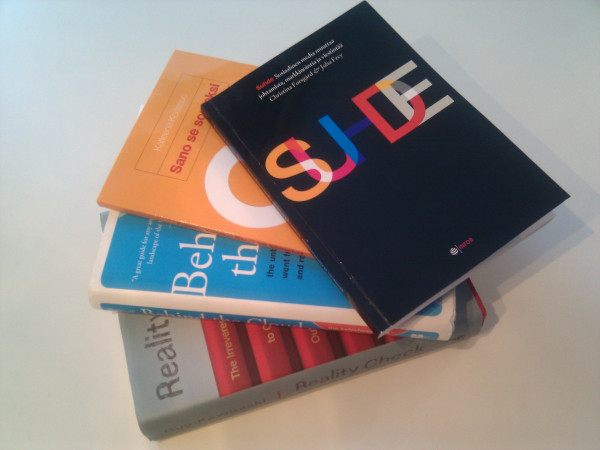
My friends Christina Forsgård and Juha Frey have written an interesting book about social media, and how it is inevitably changing the leadership/management, marketing and communication. I’ve discussed this book in Finnish, here are few points I translated into English. The name of the book is SUHDE, which means Relationship in Finnish.

First, a confession: I am somewhat biased in the topic of social media. I do already believe that we’re in the middle of the paradigm shift when it comes to communication and the way we work. Christina’s & Juha’s book have a strong message to C-level, “this is something you have to understand as it affects on your entire organization”.

The book describes and crystallizes the on-going change:

This is not a social media tool exercise; this is about a fundamental change in the way we communicate and work.

Unfortunately the public discussion in Finland has reduced social media into Facebook only. This reminds me of my favorite quotes from Sirkku Peltola’s play (my translation):

Poor you, carefully watching the tiny candle on the table while the entire mansion is burning behind your back!

I very much like the clarity by which Christina and Juha have identified the key areas of change, and managed to draw the big picture for the leaders – including the threats. Ignoring social media is a big risk, your mansion will burn, (and your bonuses too).

It’s Management Responsibility. The power of social media will be realized only if the management is active part of the game. The success requires new kind of leadership and a supporting organizational structure. In ‘Silo Organizations’ with high power distance between the management and personnel, acting in a collaborative, social way is not familiar inside the organization, and therefore double as hard if not impossible, outside of it. Collaborative, social way of working is not a responsibility of the communication or marketing department, but the management’s!

All the Moomins in the Valley? In the cosy launch event of the book Juha Frey compared collaborative, social way of working to the Moomin Valley and its lovely inhabitants. If the personnel of the organization acts impersonally and by too strict rules when communicating with its various stakeholders (blogging, tweeting and discussing) – it will be experienced as not genuine but fake. Successful utilization of social media requires personalities, or at least a personal touch!

Companies should build their social media presence as a joint effort, with passion and authenticity. In case where social media activities are mechanic and not interactive, or the activities are outsourced to an external Social Media Guru – there’s no way to become ‘digi-mature’ (Juha’s word referring to organization’s maturity with social media), not even ‘digi-teenager’.

Marketing Communication Professionals must unite. Juha’s and Christina’s message to every communication and marketing professional is clear: stop complaining and defending your responsibility area, start the work to find suitable roles, and finally explore your own attitude towards the new way of working:

  • Customers and partners are not passive targets for your activities but active players in the same equation.
  • Social media is primarily not sales and marketing channel, but a channel and tool for the new kind of PR/work on the relationships.
  • It’s time to leave the illusion of control. The discussion about your brand is no longer possible to control – but you can, and you should, participate in that discussion.

The book very vividly describes how the mechanisms of influence have changed, and further how good social media strategy and activities, and relationships based on trust, lead to a more stable and long-lived customer and partner relationships. It’s all about the relationships!

One of the wisest moves the writers have made is to leave the tools discussion out of the scope: various tool set instructions get old at the moment they are written. I would like to call SUHDE book as “A Handbook of Understanding the Collaborative, Social Way of Working”. There are many important themes in the book, which I did not touched now. I will certainly come back to these later on. A recommended read (if you can Finnish).

Move your focus away from the tiny candle – it does not warm up for a long time.

Follow

Get every new post delivered to your Inbox.

Join 7,018 other followers

%d bloggers like this: