Social Business, Power Balance and Trust
For a knowledge worker, it's no longer enough to be a good team player, you have to be a good network player. My preso in the International Woman’s Day @ Finnish Technology Industries.
Mar 17
For a knowledge worker, it's no longer enough to be a good team player, you have to be a good network player. My preso in the International Woman’s Day @ Finnish Technology Industries.
Focus on people practices, have healthy attitude towards control and risks, nurture relationships, networks & innovation, think power balance and ‘people units’.
Nov 19

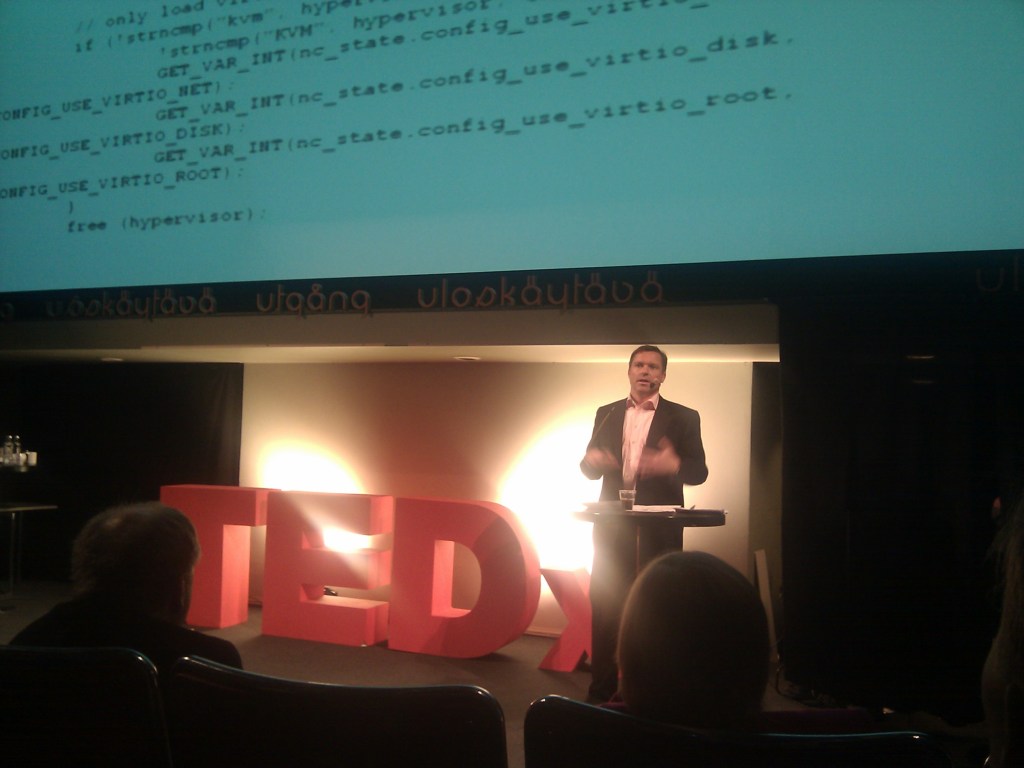
Mårten Mickos – and some source code – on the stage @ TEDxHelsinki
My brain is bubbling after the TEDxHelsinki event – a creatively built lineup of innovative speakers. The themes were exactly those I’ve been working on lately: Entrepreneurship, innovation, age & generations, and leadership. So here are random thoughts I’d like to share.
Jul 30

A beautiful moment I managed to capture in the Helsinki summer!
I’ve earlier blogged about how I find intuition and seeing the value of the tacit knowledge as very interesting perspectives for the decision-making. As social business and new ways of working are now changing the organizations and the entire business landscape, and further adding to the complexity – I’ll find it even more interesting to study decision-making and how understanding is created.
I was looking for something else from my bookshelf and found the good old book by Stephen P. Robbins “Essentials of Organizational Behavior”, and randomly checked out the chapter about individual differences in decision-making. What I found was an interesting quadrant that describes the leadership styles related to the decision-making, it has two axes: Way of Thinking and Tolerance for Ambiguity. The four styles of decision-making are: Directive, Analytical, Conceptual, and Behavioral.

Decision-Style Model. Source: A.J. Rowe and J.D. Boulgarides, Managerial Decision Making (Prentice Hall 1992)
Apr 3

These two beauties live with me: the one on the left have managed to develop quite good muscles, the one on the right side have a style of her own, a bit Picasso-like shape. She’s a creation by my talented ex-father-in-law Georg Korolkoff.
I stumbled upon a beautiful video about Michael Wolff, an acknowledged British graphic designer. I am not a part of the design professionals’ clan, but his message touched me. I think his way of thinking is applicable to all of us knowledge workers who are trying to cope with the changing work environment.
As part of my unlearning and learning process towards better understanding of Social Business I’ve been thinking back the time I worked for a Swedish Supply Chain Management (SCM) company IBS.
Yes, I am recalling the attempts we made in order to build a platform for a global wholesale distribution, the concept was called as Virtual Enterprise.
It is now most interesting to follow the discussion about social business design and to find many similar perspectives.
Simultaneously with The Power of Pull, a warmly recommended read, I have been re-reading older European research about business process design (pdf), written by two Swiss gentlemen Elgar Fleisch and Hubert Österle. Already eighteen years ago (!) in 1993 they created an interesting concept of Integration Area that refers to organizational processes which are characterized by high dependency, and therefore require a high degree of coordination.
They discuss the complexity of inter-organizational networking which is associated with human interaction, organization structure, and the culture. In order to reduce this complexity, Fleisch and Österle presented the Coordination Areas. The five coordination areas that are highly dependent of each other are: Supply Chain Management, Relationship Management, Innovation, Infrastructure, and Organization Development.