Social Media, Value Creation and the Risk of Missing Out
Knowledge workers must change, adopt and adapt: the way we learn, listen, help, discuss, search, collaborate, combine, produce, and create value.
Sep 1
Knowledge workers must change, adopt and adapt: the way we learn, listen, help, discuss, search, collaborate, combine, produce, and create value.
Nov 19

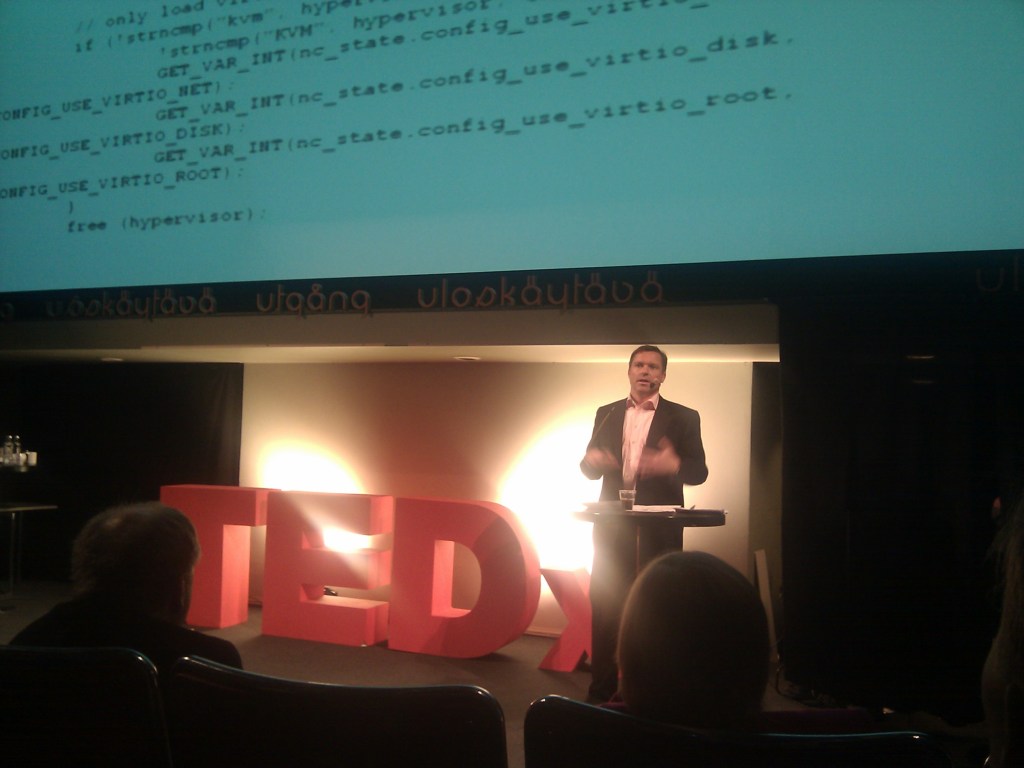
Mårten Mickos – and some source code – on the stage @ TEDxHelsinki
My brain is bubbling after the TEDxHelsinki event – a creatively built lineup of innovative speakers. The themes were exactly those I’ve been working on lately: Entrepreneurship, innovation, age & generations, and leadership. So here are random thoughts I’d like to share.
Jul 30

A beautiful moment I managed to capture in the Helsinki summer!
I’ve earlier blogged about how I find intuition and seeing the value of the tacit knowledge as very interesting perspectives for the decision-making. As social business and new ways of working are now changing the organizations and the entire business landscape, and further adding to the complexity – I’ll find it even more interesting to study decision-making and how understanding is created.
I was looking for something else from my bookshelf and found the good old book by Stephen P. Robbins “Essentials of Organizational Behavior”, and randomly checked out the chapter about individual differences in decision-making. What I found was an interesting quadrant that describes the leadership styles related to the decision-making, it has two axes: Way of Thinking and Tolerance for Ambiguity. The four styles of decision-making are: Directive, Analytical, Conceptual, and Behavioral.

Decision-Style Model. Source: A.J. Rowe and J.D. Boulgarides, Managerial Decision Making (Prentice Hall 1992)
Jan 16

Guy Kawasaki’s Note to Me @ Paris 2010
Inspired by an interview of Francis Ford Coppola and by an old article about Ernest Hemingway, I compared their advice to my experiences as an entrepreneur.
I’ve blogged earlier about my favorite topic, tacit knowledge and its role in personal and organizational learning. Francis Ford Coppola’s words took me back to these thoughts. In the web magazine The 99 Percent’s interview ‘On Risk, Money, Craft & Collaboration’ he describes his working methods and techniques, for example how making notes, e.g. writing down the first impressions of a novel, helps him to find what’s essential in it.
I have a habit of making notes all the time, not only in work related meetings and workshops, but also of novels, TV programs, movies, and discussions. When I look back at my notes I often find a new angle to the subject at hands, and realize that often my notes are implying something tacit, a piece of knowledge, an idea based on the quick unconscious association.
In the beginning of interview Mr. Coppola presents his code of ethics that directs his filmmaking. I’ll find it very interesting:
With little bit of imagination I dare to compare this to mine and my friends’ situation as entrepreneurs. These points tickle my thinking: Firstly, for an entrepreneur it is important to have a clear vision based on your big idea, which in turn should be based on the real customer need you’ve seen, maybe based the weak-ish signals you’ve seen before others have. Anyways, your basic idea must be robust. It is your original screenplay, your starting point.
Secondly, Coppola’s request for the most modern technology: that’s an easy one. In my case it is about utilizing Cloud Computing and during the coming months I need better understanding what part Social Technology have in my business. I have no clear picture of it yet. There’s luckily a very interesting discussion on-going (in Twitter) about social business. Just search #socbiz or #e20 in Twitter, and you’ll see what I mean. Learning new things daily!
Francis Ford Coppola’s third point about financing is one of the key (worrying) issues for an entrepreneur. As both in filmmaking and for entrepreneurship, it is a question about how much independence you have. For Coppola financing must be easy nowadays, but for young entrepreneurs it is often a major pain. It takes a lot of energy and time, which temporarily can cut off some of the enthusiasm.
Learning, Risk Taking and Collaboration as Key Capabilities
All these essential issues points at learning, our capability to unlearn and learn is central. To change and to be able to see what is not visible: the tacit things, the weak signals. One sentence in Coppola’s interview shows how important learning is even with 45 years successful career, he says:
I just finished a film a few days ago, and I came home and said I learned so much today. So if I can come home from working on a little film after doing it for 45 years and say, “I learned so much today,” that shows something about the cinema. Because the cinema is very young. It’s only 100 years old.
His humble quote is very true in any business. As our business environment is in huge change, we need to see it as new every day. For an entrepreneur this means making best guesses and taking risks. Francis Ford Coppola asks a striking question to which every entrepreneur can relate to:
If you don’t take a risk then how are you going to make something really beautiful, that hasn’t been seen before?
Indeed. Further Mr. Coppola shares his idea of collaboration and his role as a director, with wise words:
You must never be the kind of director, I think maybe I was when I was 18, “No, no, no, I know best.” That’s not good. You can make the decision that you feel is best, but listen to everyone, because cinema is collaboration. I always like to say that collaboration is the sex of art because you take from everyone you’re working with.
His words remind me of Mitch Joel’s recent post ‘Market of One’, where he writes:
Just because you do something (or don’t do something) is no indication of how the market actually is and reacts.
A recommended read, you may recognize the pattern in your business environment, among partners, business angels, VCs. For an entrepreneur it is vital to listen to everyone, be curious, to truly collaborate, and not make assumptions based on your personal opinion only.
To me entrepreneurship is about learning, experimenting, collaborating, and taking risks. It is an adventure. And I feel like an adventurer.
We all have our own personal methods and tools to manage the adventure. For me it is a cocktail of many things, the base on my beloved Systems Thinking, but to name one thing that has changed my way of working: social media. After I’ve managed to find ‘my people’, especially in Twitter, social media has opened a new world of knowledge sharing and valuable, most interesting global network of smart people. Whenever I have time to participate I learn.
Another result of intense learning and studying within social media sphere is this blog. I started blogging as I felt that I need to write down the (often unstructured) ideas and thoughts, and get feedback from my network of smart people. The feedback is very valuable for the learning process: when I write I am often developing an ad hoc idea and the feedback makes me think and rethink. I do need that.
Related to this experience of making notes and blogging too, I share a wonderful old article of Hemingway in Cuba (The Atlantic, 1965) which partly inspired me to write this post. Hemingway experienced writing as inventing. Here’s a quote by him which I like very much:
Fiction-writing, Hemingway felt, was to invent out of knowledge. “To invent out of knowledge means to produce inventions that are true. Every man should have a built-in automatic crap detector operating inside him. It also should have a manual drill and a crank handle in case the machine breaks down. If you’re going to write, you have to find out what’s bad for you. Part of that you learn fast, and then you learn what’s good for you.”
That’s basically what every entrepreneur needs too: Knowledge (network) out of which to invent, and a curious, open mind with a built-in crap detector.
I believe I don’t have to explain that.
Jan 6

Photo by me @ Lanzarote 2010
I have chosen Quiet is the New Loud as my motto for January, and for the rest of the year 2011. With that I refer to tacit knowledge and its value.
I am inspired by the idea of tacit knowledge flow, a flow that relies on trust-based relationships. In these times of huge amount of data, paradoxically it is tacit knowledge that best supports value creation.
Rich flows of tacit knowledge are needed for success:
We have unforeseen number of software tools and technologies available to support these flows. Still it is primarily not about the tools and processes. Most of all it is about an attitude – an attitude of the individuals forming a team, working group, or an organization. An attitude that embraces learning, openness, and transparency.
This is not happening overnight but I do believe that Quiet will be more valuable than Shouting Out Loud.
If you haven’t read John Hagel’s latest blog post about tacit knowledge, trust-based relationships, and talent development, please do so. It is an excellent read. Here’s a snippet from it:
As we enter a new decade, the greatest wealth will be created by a new set of entrepreneurs. These entrepreneurs will understand and address the unmet needs of those who want to participate in environments that foster deep, trust-based relationships across both virtual and physical space. These environments will focus participants on the opportunity to learn faster by working together in addressing challenges that draw on the tacit knowledge of each participant.
I hope that I can live up to what John Hagel calls for: being that new kind of entrepreneur. One of the first steps for me is to apply Quiet is the New Loud Attitude.
Have a great long weekend!
PS. My headline ‘Quiet is the new loud’ is actually album name of a Norwegian indie band Kings of Convenience.