Human Capital in the Cloud
Clouding enables beautiful things - talent management in a new way. Why don’t we speak more often about Human Capital (HC) instead of Human Resources (HR)?
Dec 16
Clouding enables beautiful things - talent management in a new way. Why don’t we speak more often about Human Capital (HC) instead of Human Resources (HR)?
Dec 31
This is a summary post of the topics I have been writing about during 2011. Topics as the Culture of Curiosity, Listening and Respect, Trust-based Collaboration, and the Wrong Lind of Silence.
Feb 15

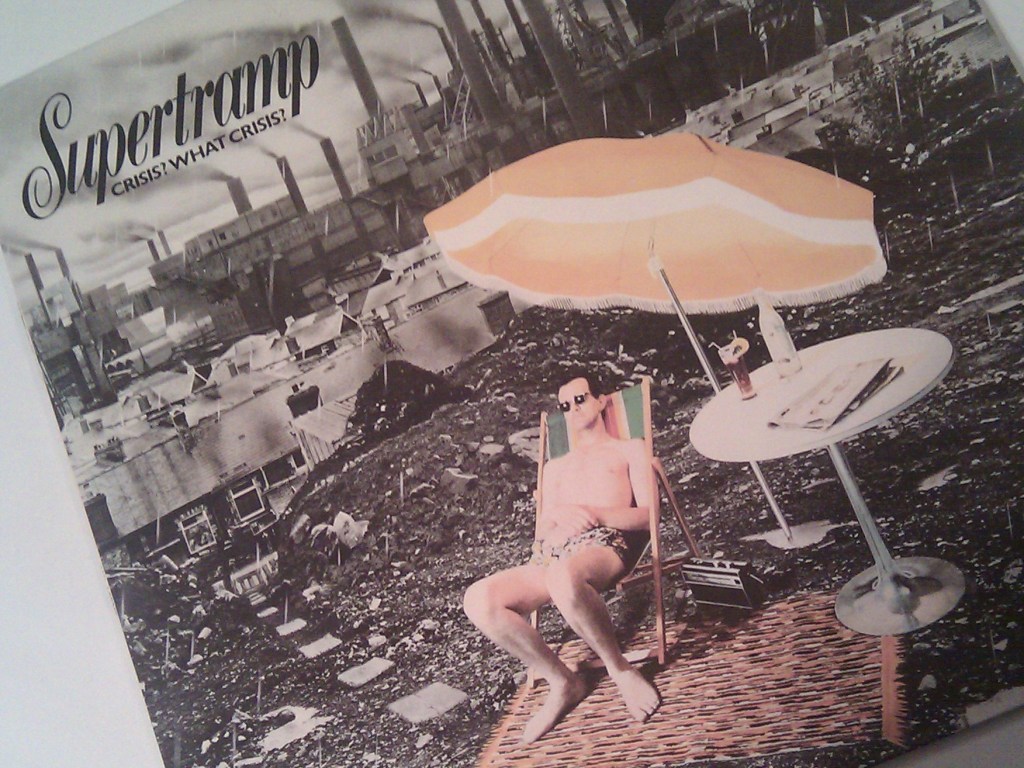
Supertramp album from 1975 – Photo by me
I recently found my old thesis, and yes, some of its topics and content are (still) relevant, as this one: the evolution of organization and work structures. The very same topic Esko Kilpi is researching. The discussion in my old thesis and Esko’s blog posts inspire me to learn more about this topic.
One chapter in my thesis starts with a quote by Michael Porter:
“Industries are profitable not because they are sexy or high tech; they are profitable only if their structures are attractive.”
Well put. Many industries and organizations are trying to score right under the constant change requiring new type of more adaptable structures. The development has been very rapid and raises increased demand for choice, chance, change and flexibility.
Dec 12
My friends have patiently tolerated my numerous stories about Professor Esa Saarinen’s Paphos Classic seminar I attended in September this year. Indeed, it was the most amazing and surprising week, a true celebration of creativity and humanity. However impossible it is to describe it, I’ll try every now then. Anyways, this post is about a related connection I observed.
I often admire John Hagel’s articles in Harvard Business Review, via Twitter I happened to find a presentation “The Big Shift: Challenge and Opportunity for Women” that he gave at the TEDx Bay Area Woman conference in December 8th, 2010.
His message took me right back to Paphos topics. Before going further I shortly describe which part of Esa Saarinen’s work he reminded me of. In the first seminar morning Esa started the day by saying something like this:
We may have a surprisingly narrow sense of ourselves.
With this sentence Esa Saarinen paved the way to his theory of Systems Intelligence which he defines as follows: “Systems Intelligence (SI) involves the ability to use the human sensibilities of systems and reasoning about systems in order to adaptively carry out productive actions within and with respect to systems.”
All of us have two thinking systems, so-called System 1 and System 2. System 1 thinking can be described as automatic, associative, and intuitive. System 2 thinking is dominating in the work places: you better be strictly rational and always take the various rules into account in your thinking. It’s all about being analytical and systematical, that’s very much appreciated! We can’t afford emotions at the work place, and so on.
It is easy and very tempting to see the opposite, systems stupidity. In every day work situations the System 2 thinking is active and often unintentionally blocking System 1 thinking – and therefore narrowing the possibilities at hands. Indeed, very often we are having a surprisingly narrow sense of ourselves! When both systems are active, there’s a room for intuition, interaction and emotions which in turn nourish and create the trust-based relationships. At its best this opens an Ocean of Opportunities!
Sticking to System 2 thinking doesn’t kill you yet, but it does not strengthen you either.
So, my humble observation is that John Hagel and Esa Saarinen are sharing the same idea; looking it from different perspectives, using different notions. John Hagel describes the on-going powerful change of how we in the business world must focus on knowledge flows, instead of knowledge stocks. A bit paradoxically, in these times when we have huge amount of data available, the most value comes from the tacit knowledge flows.
Sharing of the tacit knowledge requires trust-based relationships. In absence of trust, there is often no access to tacit knowledge. The winner is the one who manages to build rich flows of tacit knowledge and scale it.
Hagel draws a picture of the two opposites: Masculine & Feminine Archetypes. When challenged the approach a masculine archetype chooses is: emotions aside, never show your vulnerability, be strictly analytical. It’s all about transactions. The feminine archetype is defined as having: a strong intuition, associativity, emotions and showing vulnerability. The relationships are the most essential core.
John Hagel ends his excellent presentation (13 minutes of pure gold) with these words:
“Deep tacit knowledge flow relies on massive scale of trust-based relationships. And the future belongs to the “feminine archetype”; because it’s about trusted relationships for tacit knowledge sharing.”
There’s not much to add to that. I’m all in.
I feel very passionate about this: two of my favorite thinkers around the same topic. I am looking forward to see how organizations manage to develop in this area. When and how will “The Hagel-Saarinen Approach” (my own, totally unofficial notion!) flow into organizations around the world?
Are You Systems Intelligent?