Social Media, Value Creation and the Risk of Missing Out
Knowledge workers must change, adopt and adapt: the way we learn, listen, help, discuss, search, collaborate, combine, produce, and create value.
Sep 1
Knowledge workers must change, adopt and adapt: the way we learn, listen, help, discuss, search, collaborate, combine, produce, and create value.
Focus on people practices, have healthy attitude towards control and risks, nurture relationships, networks & innovation, think power balance and ‘people units’.
Feb 15

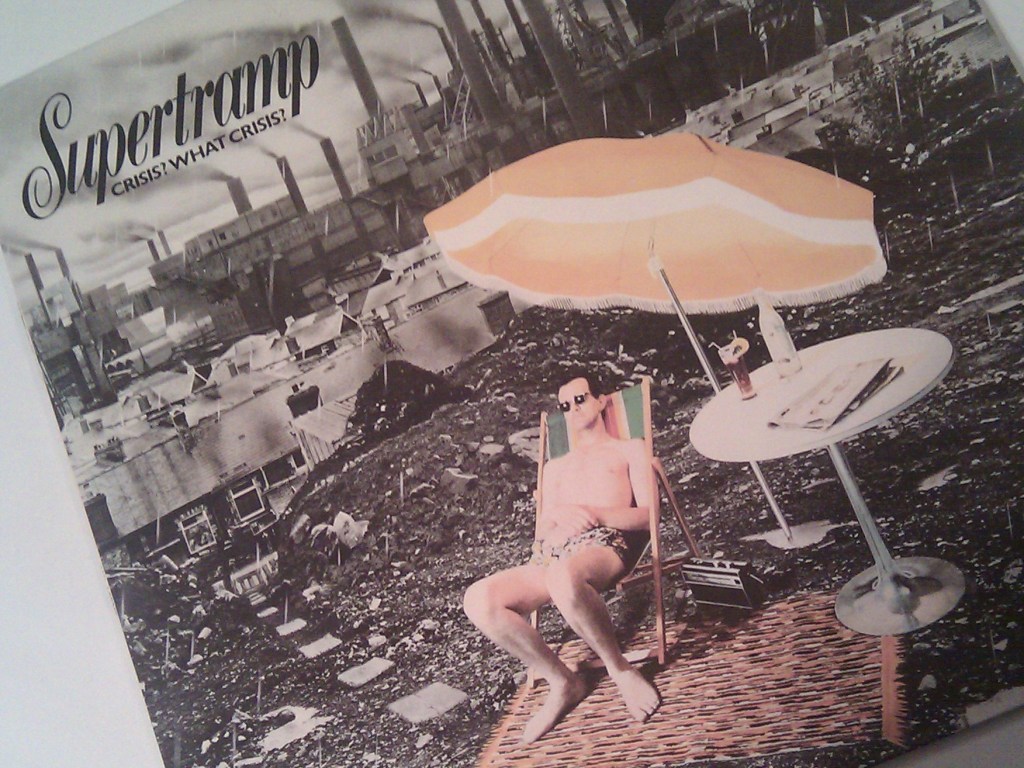
Supertramp album from 1975 – Photo by me
I recently found my old thesis, and yes, some of its topics and content are (still) relevant, as this one: the evolution of organization and work structures. The very same topic Esko Kilpi is researching. The discussion in my old thesis and Esko’s blog posts inspire me to learn more about this topic.
One chapter in my thesis starts with a quote by Michael Porter:
“Industries are profitable not because they are sexy or high tech; they are profitable only if their structures are attractive.”
Well put. Many industries and organizations are trying to score right under the constant change requiring new type of more adaptable structures. The development has been very rapid and raises increased demand for choice, chance, change and flexibility.
Jan 25
A quick post about playing with words, notions and associations, and about what I did 10 years ago – and in the end of the post I make a promise!
Years ago I was in Supply Chain Management business, and now my startup is developing a SaaS application for businesses, in a #E20 style. That is why I am very curious about Social CRM, SCM and Enterprise 2.0.
Two recent ‘good bits’ started a thought process: 1) Jacob Morgan’s tweet and 2) Seth Godin’s fantastic post.
Seth Godin wrote about “the pleasant reassurance of new words”:
“It’s a lot easier for an organization to adopt new words than it is to actually change anything. Real change is uncomfortable. If it’s not feeling that way, you’ve probably just adopted new words.”
I do agree, seen that happen.
Jan 3
Many of us have organized and managed our organizations and business operations with the help of a traditional family tree type organization chart. It feels familiar and sometimes it can be effective. An additional ‘benefit’ of it has been that the management has had a map for identification of who to blame when something has gone wrong.
I’ve personally experienced how poorly this model sometimes works: the complexity of the business environment is increasing and it’s often hard to either manage operations effectively or innovate.
Many of us also need to skip the illusion of full control. Better to get use to less unpredictable, more global, mobile and social business environment. The tough challenges lie in the areas of communication, coordination, learning, and leadership.

Suitably I found an old book from my home library, Stafford Beer’s “Diagnosing the System for Organizations”. Beer discusses the science of organizing effectively – Cybernetics. The book is written 1985 (!) but while browsing it, I was amazed how accurate its statements are. And I’ve always had an odd crush for the System Theory; yes, I’ve read my Schoderbek, Schoderbek & Kefalas!
Here’s an example of Stafford Beer’s thoughts on the organizational structure:
“…if the structure is dysfunctional, then no amount of financial wizardry, of insightful man-management, of business technique, will save the day. Increasingly, it seems to me, the organizational structures we inherited do not work.”
Stafford Beer has also coined a notion I like: “the purpose of a system is what it does”. Very simple and well put. Here’s in more detail what he said in one of his lectures:
“According to the cybernetician the purpose of a system is what it does. This is a basic dictum. It stands for bald fact, which makes a better starting point in seeking understanding than the familiar attributions of good intention, prejudices about expectations, moral judgment or sheer ignorance of circumstances.”
Seeking understanding, identifying the purpose, and reorganizing organizational structure to a more dynamic one with adaptive connectivity both internally and within the ecosystem they are part of. Indeed something for organizations to study.
However, strictly drawn boundaries between the functions, silo-like structures, are still flourishing. Lots of interesting research can be found on this topic. One of my favorites is Harold Jarche, a consultant and researcher I follow on Twitter. He wrote interestingly in his recent blog post:
“The big idea that is catching on and may take shape in 2011 is the integration of organizational support. Enough people are realizing that our compartmentalized approach to supporting work doesn’t help in a highly networked world. Why should HR, IT, Finance, Training, KM, OD, Marketing etc. be separate functions? It’s time to rid our organizations of Taylor’s ghost and I’m detecting a small groundswell of similar sentiments like radically different management.”
I could not agree more with him. The organizational structure, in general and for the support functions, needs fresh approach, a new mindset. Harold Jarche’s passion is in helping organizations re-integrate work and learning. The new mindset must integrate these two. A learning organization can adapt and adopt.
There is naturally a need for tools to support the transformation: social software. These tools support organizations in the creation of trusted relationships which are required for tacit knowledge sharing. I’ve earlier blogged about the need of knowledge flows instead of knowledge stocks.
It is easy to find excellent thinking and analysis around social software, for example by Dion Hinchcliffe, R “Ray” Wang, Oscar Berg and rest of the people on my Enterprise 2.0 Twitter list.
I’ve had my share of ‘silo frustration’ and will eagerly continue to study this topic. What exactly should be done then? I’ll leave that to the professionals, but I do believe that on a personal level some of the key areas can be found in this diagram “Principles of being a Creativist” (which I found here):

Accordingly, my new year’s resolution is that I will do my best to follow these Creativist principles.
My open questions are:
I’d love to hear your point of view meanwhile I’m trying to learn more!